
Who was Johann Sebastian Bach
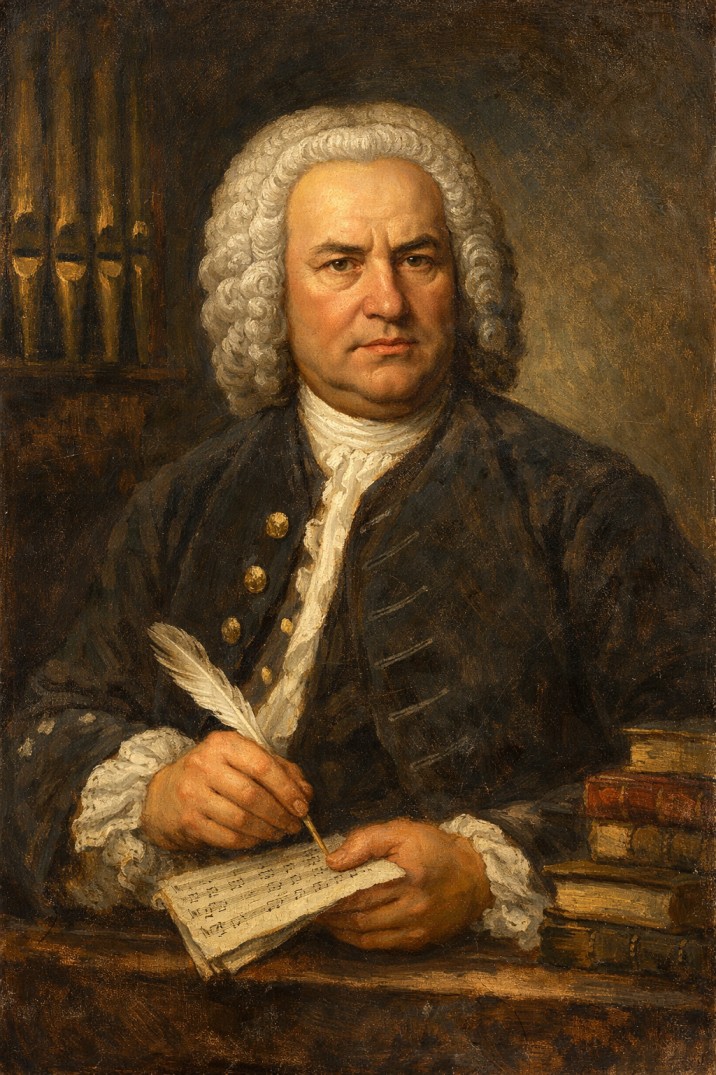
Some people show up in music history like a comet: they blaze, change everything, and vanish quickly. Bach wasn’t like that. Bach is closer to a mountain. You can spend an entire lifetime looking from different angles and you’ll still find a new outline, a hidden detail, a path you hadn’t noticed.
He lived from 1685 to 1750, was born in Germany (Eisenach), and died in Leipzig, near the end of the Baroque period.
What’s funny is that he didn’t live as a universally celebrated “genius” the way we picture it today. Bach was a professional, a working musician, someone with deadlines, bosses, students, a choir to rehearse, organists to train, instruments to inspect, church services to fill with sound. And inside that almost administrative routine, he wrote music that feels like it came from somewhere larger than the workday.
A last name that was already music
Before talking about Bach the individual, it helps to notice something that changes how you see the story: Bach didn’t appear out of nowhere. He was born into a family so packed with musicians that being “a Bach” nearly meant being “a musician.” It was a dynasty spread across towns in central Germany, working as instrumentalists, organists, composers, teachers.
That background explains two traits that people sometimes miss:
-
How naturally he mastered musical language, as if it were a childhood dialect.
-
His respect for tradition without being chained to it. Bach learned from what already existed and, when he sensed a better possibility, he pushed the door open and stepped through.
He grew up where music wasn’t “a luxury,” it was a trade. And that gives his work a special flavor: it shines, but it also has craftsmanship.
Childhood, loss, and stubbornness
Bach became an orphan while still young. It’s one of those facts that, if you read it fast, feels like a minor biography detail. If you slow down, you feel the weight: losing both parents early changes anyone. For him, music was shelter, tool, and path.
There’s a recurring image in stories about Bach: the young man copying scores by dim light, insisting on learning hard things. Not every anecdote about great composers is trustworthy exactly as it circulates, but the core idea makes sense. He had a kind of studious stubbornness. It wasn’t just talent. It was hunger.
And you can hear it. There was moments of obvious beauty, almost immediate in the so called “melodias ornamentais de bach“. But above all he has a beauty that reveals itself through familiarity, like learning to love a place because you returned to it again and again.
The places where Bach became Bach
His life is often told through cities and job titles, and that isn’t just biographer habit. Each phase changed the kind of music he wrote.
This table helps organize the journey:
| Phase | Where | What it meant |
|---|---|---|
| Early professional years | Arnstadt and Mühlhausen | Bach as a young organist, already full of personality, testing the limits of the instrument and of institutions |
| Court maturity | Weimar | A more sophisticated environment, where he deepens his organ writing and begins expanding his ambitions |
| The “instrumental” period | Köthen | Fewer church obligations, more focus on chamber and instrumental music |
| The great final marathon | Leipzig | Cantor and music director, responsible for church music, producing an intense stream of cantatas and monumental works |
And here comes a major turning point: in Leipzig, Bach became the Thomaskantor, tied to St. Thomas Church, and he stayed there until his death. That post wasn’t glamour, it was responsibility. He had to supply music for multiple churches, train the choir, deal with the city’s demands. It’s almost funny to think that while we treat certain works today as sacred relics, many were born under the mood of “I need to deliver this by Sunday.”
What he wrote and why it feels endless
Saying Bach wrote “many works” barely scratches it. He composed more than a thousand pieces, and what’s striking isn’t just the volume. It’s the variety and the steady level of quality.
Instead of dumping a catalog, I’d rather give you a map that actually makes sense in real life, when someone wants to enter Bach’s world without getting lost.
When you want Bach at his most “architectural”
Picture him as an architect building cathedrals out of notes.
The Well-Tempered Clavier is almost a laboratory of harmonic possibilities and counterpoint, a book musicians study the way you’d study grammar and poetry at the same time. It’s the kind of music that, on a first listen, can feel “cerebral.” On the third, you start noticing that it breathes.
When you want Bach with energy and sparkle
The Brandenburg Concertos sound like Bach saying, “let’s play with this.” They’re full of instrumental invention, conversation between instruments, that feeling of living motion. It’s Bach in a social mood, almost festive, even when the structure is sophisticated.
When you want that beautiful pain that doesn’t crush you, but stays
The large sacred works are a world of their own. The St Matthew Passion and the Mass in B minor show Bach at the peak of his ability to fuse drama, spirituality, narrative, and technique. There are moments where time seems to stop. Not because of special effects. Because the music finds a way to say something ordinary language can’t.
And yes, it’s interesting: today these pieces are treated like monuments, but there was a period when they were less present in concert life. A major part of Bach’s “revival” happened in the 19th century, when Felix Mendelssohn conducted a performance of the St Matthew Passion in 1829, helping to reignite interest in these works.
Bach’s secret that everyone feels, even without knowing how to explain it
People talk a lot about Bach as a master of counterpoint. And he was. But if we get stuck in technical vocabulary, we lose the fun.
What listeners sense, even without naming it, is something else:
Bach can make multiple independent voices feel like a human conversation.
One line says something, another replies, another cuts across, someone insists, someone yields. In music, that becomes fugue, chorale, invention, canon. In the experience, it becomes life.
And then the miracle happens: structure doesn’t cool the emotion. It strengthens it. In Bach, order is the path emotion uses to become more powerful.
Bach wasn’t only “serious”
There’s a myth that Bach is always solemn. That’s not true. He has humor, dance, rhythmic mischief. A lot of Baroque music leans on dance forms, and Bach loved that bodily pulse. Sometimes you hear a suite and think: this is refined, but it’s also grounded, it’s people moving.
And even when he’s in his most sacred mode, he doesn’t sound like someone distant from the world. He sounds like someone who knows contradictions, knows joy and loss, and doesn’t need to pretend life is simple in order to create beauty.
After him
Bach died in 1750, and that date is often treated as a symbolic marker of the end of the Baroque. But his impact crossed styles and centuries. Later composers studied Bach the way you consult a source. Not because they wanted to copy him, but because there was a way of thinking about music there that seemed inexhaustible.
There’s something almost intimate about it: you can listen to Bach while focusing, as study music. You can listen on a rainy Sunday as comfort. You can listen on a good day as a quiet celebration. His music can hold all those roles without turning into wallpaper, because it has layers. It adapts, but it doesn’t empty out.
If you want to start today, without ceremony
I won’t throw a massive list at you. Just a simple path that often works:
-
Start with something instrumental and direct, like a movement from the Brandenburg Concertos.
-
Move to a prelude from The Well-Tempered Clavier and notice how the music “walks” without hurrying.
-
When you have time and heart available, enter a larger work, like the St Matthew Passion.
And here’s a small, human, almost confessional detail: some days Bach feels “difficult.” On other days, the very same piece feels obvious, as if it had always been there. That isn’t a listener’s flaw. It’s part of the game. Bach is long-term company.
In the end, maybe the best definition is this: Johann Sebastian Bach was a working man, living a concrete life, who left behind a body of work able to cross time with a rare blend of intelligence and warmth. The more you return, the more he gives back.